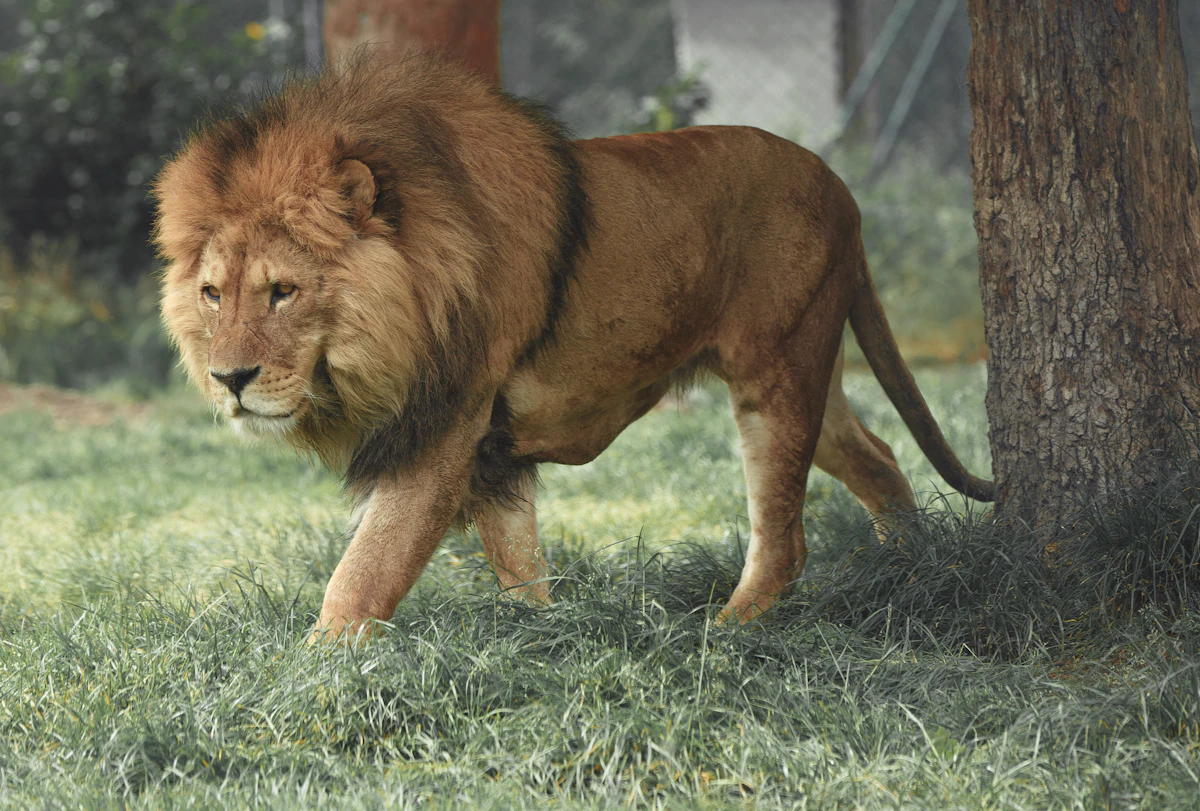
There was a moment, not so long ago in historical terms, when the Asiatic lion nearly ceased to exist. By the early 20th century, hunting, habitat loss, and conflict with farmers had reduced the entire world population of Panthera leo leo to fewer than 20 individuals, confined to a single forest in the Indian state of Gujarat. The subspecies had survived for millennia across North Africa and southwest Asia, ranging as far as Greece and Turkey. Then it was gone from everywhere except one small patch of land in India.
What happened next is one of conservation's most important stories.
The 2025 Census
Results from India's 16th Asiatic Lion Census, conducted in 2025, confirm a population of 891 individuals in the Gir landscape — an increase of 32.2% from the 674 lions counted in 2020. That number doesn't just represent a healthy population. It represents something close to a miracle.
Compare it to the early 1980s, when the population stood at roughly 250. Today's total is more than triple that figure, and the lions have expanded their range by 17%, now occupying approximately 35,000 sq km across 58 talukas in 11 districts. Some individuals are being sighted in areas — including coastal zones and scrublands — that hadn't seen lions in living memory.
What Made It Possible
The recovery is the product of decades of sustained effort across multiple governments, conservation agencies, local communities, and the Gujarat Forest Department. Key factors include:
- Strong legal protection through India's Wildlife Protection Act
- Habitat management across the Gir National Park and Wildlife Sanctuary, including control of invasive species
- Community engagement with the Maldhari pastoral community, who have historically lived alongside the lions and whose cooperation is essential
- Livestock compensation schemes that reduce the incentive for retaliatory killings when lions prey on cattle
- Rapid veterinary response following disease outbreaks, including a 2018 distemper virus episode that killed over two dozen lions
The growing population has also created a new challenge: lions are dispersing beyond the protected area boundaries in large numbers. More than half the population now lives outside Gir National Park itself, in revenue land, forests, and agricultural areas. Managing coexistence in this expanding range is the primary focus of conservation work today.
A Model for Asia
The Asiatic lion recovery is being studied by conservationists working on tiger, leopard, and snow leopard programmes across the subcontinent. The combination of firm protection, community involvement, and rapid response to threats has been identified as replicable. India's Project Tiger, which has seen tiger numbers recover from under 1,800 in 2010 to over 3,600 today, draws on similar principles.
For a subspecies that once lived on six continents and now exists only in a corner of western India, 891 animals is not the destination — it is a waypoint. The question now is whether the range can be expanded to a second site, reducing the extinction risk posed by having a single wild population.
For now, the forest is filling with roars again. That counts for a great deal.
Sources: Drishti IAS · Mongabay India · Gir National Park · India Ministry of Environment, Forest and Climate Change, 2025-2026